
Trigger events at a threshold
This guide shows how to use CSwitcher to change a model variable when a concentration crosses a threshold.
Unlike scheduled dosing, a threshold event has no predefined time: it depends on the simulated state of the model.
Before you start, follow the Quick start to install Julia, HetaSimulator, and Plots.
Create this directory with two files and run the example from it:
threshold-events/
├── index.heta  # conversion model and threshold event
└── run.jl      # simulation and plot
Define the event
Create index.heta with the complete content below:
/* A is converted into B in a compartment of constant volume. */
cell @Compartment .= 1;
A @Species { compartment: cell } .= 10;
B @Species { compartment: cell, output: true } .= 0;
conversion @Reaction { actors: A => B } := k * A * cell;
k @Const = 1e-2;

/*
  Switch the response on when B rises through the threshold.
  The trigger must cross zero from negative to positive.
*/
threshold @Const = 3;
response @Record { output: true } .= 0;
threshold_reached @CSwitcher {
  trigger: "B - threshold",
  atStart: false
};
response [threshold_reached]= 1;
As A is converted into B, the concentration of B rises. CSwitcher locates the zero of B - threshold as it crosses from negative to positive. The event assignment then changes response from 0 to 1. This record stores a simple on/off indicator; it does not affect the reaction.
The response remains 1 after the event. An event assignment is not a continuously evaluated rule and does not automatically reset when the concentration falls.
Simulate the model
Create run.jl:
using HetaSimulator, Plots

platform = load_platform(".")
model = models(platform)[:nameless]
Scenario(model, (0., 120.)) |> sim |> plot
Run the file in Julia. Both B and response are plotted because they have output: true.
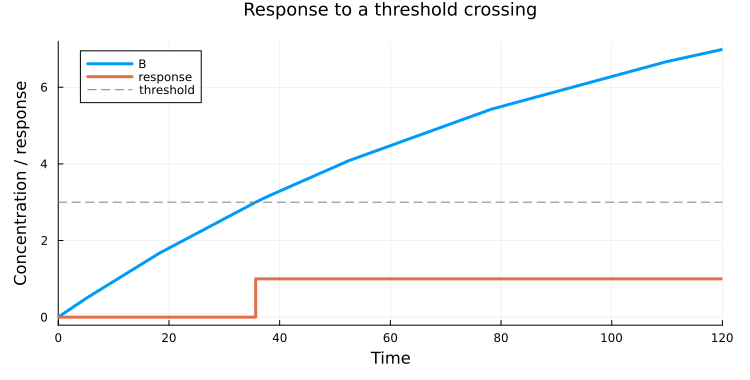
The response changes at approximately t = 35.7, when B reaches 3. The dashed threshold line is added to the illustration for reference.
Choose the crossing direction
Use B - threshold to detect a rising concentration. For a falling concentration, use threshold - B: it becomes positive when B falls below the threshold. CSwitcher detects a negative-to-positive crossing of the expression, not both directions.
Handle the initial state
atStart controls whether the event can run immediately when its trigger is already nonnegative at the start. Its default is false.
For example, change the initial value of B to 5 in index.heta and reload the platform. With atStart: false, the response stays 0: B starts above the threshold and keeps rising, so there is no crossing. With atStart: true, the response becomes 1 immediately.
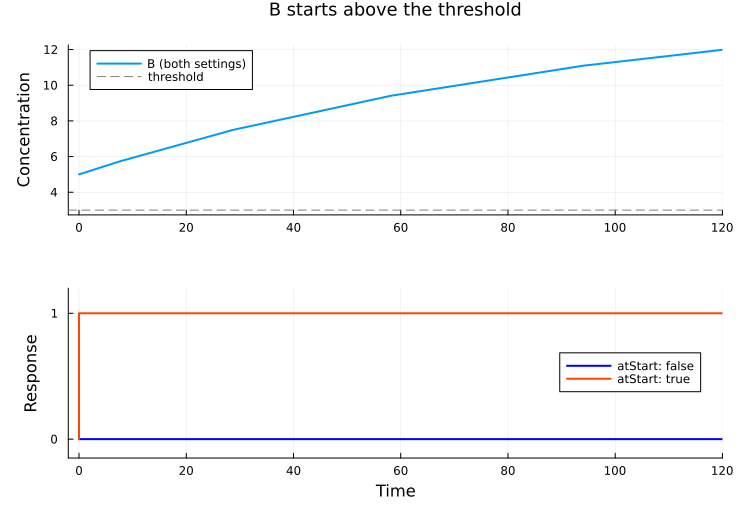
In the original example, B starts below the threshold, so either setting waits for the same crossing.